

Those who know me might find it hard to believe, but I have been known to pick up a tome once in a while. I guess there was a certain point in my life where I realized that if you don't read, you get really stupid. It's not so much a problem of ignorance, but not really using your brain enough. I read some statistic that you burn more calories sitting in a room thinking than you do watching TV. It's no wonder that America is such an obese culture; even with those great new baked Lay's potato chips.
Below, are books that I've read. The most recent are at the top.
 Acts of War
Tom Clancy My sister was actually reading a book from the Op-Center series when I went home for vacation and she seemed to be enjoying it, so I decided to pick one up as I was waiting in the airport for my delayed flight. It's the same Clancy writing style that is intriguing and face-paced. I don't think that anyone would ever consider this stuff "literature," but who cares. |
|
Sphere Michael Crichton Sphere is probably Crichton's worst book. Stupid characters, weak plot, and mediocre writing compared to his other stuff. C'est la vie. |
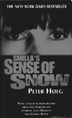 Smilla's Sense of Snow
Peter Hoeg This wasn't Time's Book of the Year for nothing. It was actually a preview of this movie that I saw that intrigued me to pick up the book, and once I did, I couldn't put it down. The writing style is extremely unique, and Mr. Hoeg obviously is an erudite fellow because the book is strewn with references that I could only chuckle and pretend that I understood. It was absolutely great until the end, when the plot when awry, but at the point, I didn't care what the hell happened--even if it did involve a strange space worm... |
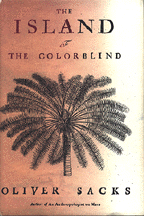 The Island of the Colorblind
Oliver Sacks Kelly had just finished reading this book and suggested it to me as a good pop science book that she really gravitated to because it was like "I was being told a story by Oliver Sacks in front of a campfire." The anecdotes were very interesting and the guy is a genius without being pretentious. My misgiving was that I had expected something more technical, but he writes books about people, not just about conditions. I have always been curious about The Man who Mistook His Wife for a Hat, and perhaps I will pick that up one day. |
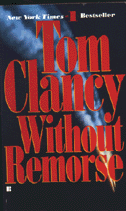 Without Remorse
Tom Clancy My first Tom Clancy book came highly recommended by several people and I was intrigued because I was told that it told the story about the mysterious "Mr. Clark" character from Clear and Present Danger and how he got so screwed up. Despite the fact that I thought the book could have been about 100 pages shorter, I really did enjoy the fast pace and the "un-put-downability" of the book. I guess everyone sorta likes stories of renegade/rogue soldiers that fight for "pure" causes. |
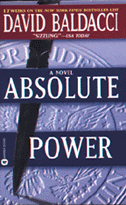 Absolute Power
David Baldacci I got all worked up about this book because I saw that the movie version starring Clint Eastwood was coming out. So I ran out to Barnes and Noble and bought the paperback and consumed it (avec all its defiencies) and excitedly went to the movie theatre on opening night only to find that it was sold out. So the next night I went again still wondering how they were going to resolve some of the issues in the book that I thought would be difficult to capture on film. Well, the movie was certainly a case of "loosely based on the novel" and I felt like walking out on multiple occasions--especially when it became clear that the main character from the book, Jack Graham, wasn't in the movie. And that Clint Eastwood, the movie's star and director, kept his character alive and made him into the hero. "W"--whatever. |
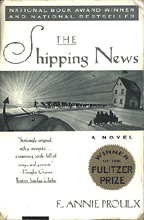 The Shipping News
E. Annie Proulx This Pulizter Prize winning novel was recommended by the old roomie, Josh, as I swaggered about the apartment aimlessly one weekend. It is a curious book because it doesn't subscribe to any of the more formulaic methods of writing a best-seller (i.e. mystery, intrigue, romance, sex). In fact the main character is overweight, unattractive and not terribly smart, but he has a good heart. And in the end, everything seemingly works out. The last paragraph reads: "For if Jack Buggit could escape from the pickle jar, if a bird with a broken neck could fly away, what else might be possible? Water may be older than light, diamonds crack in hot goat's blood, mountaintops give off cold fire, forests appear in midocean, it may happen that a crab is caught with the shadow of a hand on its back, that the wind be imprisoned in a bit of knotted string. And it may be that love sometimes occurs without pain or misery." Werd. |
|
The Lost World Michael Crichton Tim is working on the effects for the movie, so I felt a certain obligation to read this sequel to Jurassic Park. It was a sequel in the true sense of the word--repetitive characters, plots, etc. Is it possible that Crichton is losing his noodle? (On the otherhand, I did enjoy reading it...) |
 ABC of design
Lynn Gordon I was wandering around the big Barnes and Nobles downtown with my friends Austin, Annaliese and Charmilla when I spied this book. Each page contains a few paragraphs on a significant furniture designer of the 20th century, many of whom were reknown architects or graphic designers. This is definitely a coffee table book, but interesting nonetheless. |
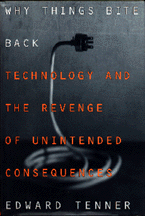 Why Things Bite Back: Technology and the Revenge of Unintended Consequences
Edward Tenner I read the review of this in Newsweek and immediately was hooked. Tenner charts the history of technological development in the 20th century and shows how there is inevitably some "revenge effect" that we never thought about. For example, advances in technology that make safer football padding, also allow the players to hit harder increasing the severity of injuries. Or, the advent of antibiotics created even tougher strains of drug resistant bacteria. You try to help people out and you get nipped in the butt. Bummer, huh? I don't think that there is anything very revolutionary here, but he does a good job of summing up his observations with fairly compelling examples. Too bad he works at Princeton... |