
| "I've been in hotter, it was called Death Valley. I've been in
lonelier, it was called Australia." -- Rally driver John Bryson, on Inner
Mongolia
Today, 100 miles on the dusty road to the desolate Ningxia Autonomous Region, a deceptively deep rut snapped the suspension on Richmond's Citroen 2CV. The car reeled off the road, and the right side collapsed. Within minutes an audience of Chinese, wearing oil-stained baggy pants cinched tightly around their slight frames, stood gaping and giggling. They crowded closer as Richmond and his co-driver, Richard Newman, assessed the damage.
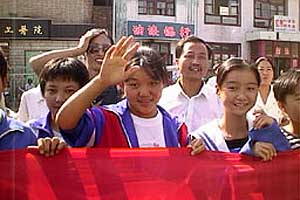 Entire towns turn out to welcome the rally. The past two days in parched industrial China has been a two-way carnival sideshow, with both the motorists and the natives finding each other equally amusing and freakish. As we pass through the endless grasslands, factories and smooth-mud houses of Inner Mongolia, the Chinese descend on the cars like bees on honey, honking horns, kicking tires and rubbing the hairy forearms of the drivers in amazement. In the semi-desert region of the Ningxia Autonomous Region, entire towns turn out to greet the rally, placing flowers, beer and yellow melons in the cars. The drivers, in turn, are capturing the curious natives on film. They snap away at wispy-bearded men on donkey carts, at shy schoolgirls in pigtails, at pool sharks shooting on dusty outdoor tables, and at China's Muslims, the skull-capped Huis.
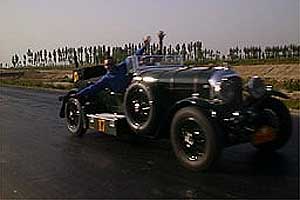 American William Binnie gives the locals a show in his 1928 Bentley. Filming them both are scores of green-shirted police and public security officials stationed throughout the route. When they are not filming the competitors, filming the natives or gawking at the automobiles, the officials are scattering the peasants so that their comrades can take pictures of them posing by, or sitting in, a car they select from the convoy. The most popular backdrop by far is Hermann the German's 1907 La France, a former fire engine and the only chain-drive car in the rally. Hermann, a consummate ham, has been happy to oblige. Blazing at 60 to 70 mph (twice the speed suggested by rally organizers) Hermann plays chicken with tractors, salutes stern high officials, and tosses pink daisies to grim-faced policewomen.
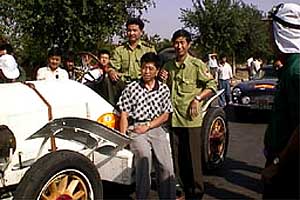 Chinese police pose in "Hermann the German's" 1907 La France. Yet, behind his facade, Hermann is hurting. His co-driver, John Dick, has taken refuge in Hermann's unofficial backup car, a Land Rover (rally rules prohibit entrants from having personal support vehicles), after two days of braving the fierce wind, sun, noise and teeth-numbing rattles. Even more ominous, a valve on the La France broke not long after leaving Inner Mongolia, leaving Hermann with three, instead of four, working cylinders. Hermann says he plans to have another valve sent to Lanzhou, the next stop on the route. If it doesn't arrive, he will face the Himalayas with three-fourths power. But, while Hermann may play the class clown for a laugh on the road, he is dead serious about completing the rally. "Nothing can stop me from going to Paris," he says, his face reddish black from soot and sun. Unfortunately, it appears that Lord Edward Montagu will not be rolling into Paris with him. Though he made it to Yinchuan, limping along with a wounded radiator, he's conceded that his 1915 Prince Henry Vauxhall could not make it past Tibet. Lord Montagu is going to catch a plane to Lhasa and then fly on to Katmandu where he may ride along in someone else's car, according to route coordinator Mike Sommerfield.
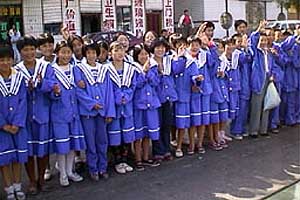 School children lining the rally route
Pictures (from top right): Brown Brothers | Popperfoto/Archive Photos | Auburn Museum/Archive Photos | Chris McKenna/ Candide Media Works | Copyright © 1997 Discovery Communications, Inc. |