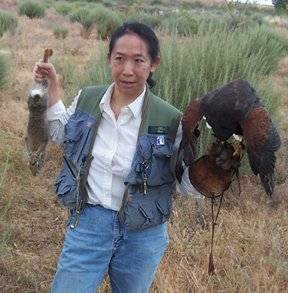
 Building a relationship with
a hawk is time consuming but very fulfilling. Hawks have their own ways
of thinking, and the way one treats it is completely different from any
ordinary animal pet.
Building a relationship with
a hawk is time consuming but very fulfilling. Hawks have their own ways
of thinking, and the way one treats it is completely different from any
ordinary animal pet.
Building a relationship with
a hawk is time consuming but very fulfilling. Hawks have their own ways
of thinking, and the way one treats it is completely different from any
ordinary animal pet.
It is not a sport for everyone: you regularly get muddy and cold and tired, and there are days when you just don't want to go out even when all other conditions are perfectly encouraging. Falconry wants those people who will go out because the bird needs to fly, it wants people who are stopped only by impending pneumonia, broken legs or death. Falconry is a lifestyle, an obsession, an addiction. Don't fool yourself into thinking you can "fit" falconry into an already busy life.
Two hours per day, average, is what falconry requires. The falconer's life bends to the hawk's needs, not the other way 'round. The foremost goal should be to make the bird into the best hunting hawk it can be. The hawk's purpose is not to prove you're cool and unique, that you have a hawk-brother spirit in your soul, or that you prefer to refer to yourself as Lord Maulkworth of Faulnwood Castle and you just know no Lord is complete without a prop faulcon. If you feel that way, hit your browser's "Back" button a few times and go away. If you want to learn about becoming a falconer, read on and welcome.
There are goals or stages that the apprentice falconer should attain. Barring disasters, if you cannot accomplish these things within the space of 2 years, you should consider another sport. These things are:
 Trapping your hawk. Getting it to wear the hood.
Learning weight control (for the hawk, not
you, although the latter helps)
Training it to catch game with you.
Bringing it through the molt. A Rage for Falcons by Stephen
Bodio. It is not a falconry manual, but rather the best book on what it's
like to be a falconer. Reading him can teach the wannabe falconer much,
as well as dispel a lot of tension for the experienced.
North American Falconry and Hunting
Hawks by Frank Beebe and Harold Webster. The modern falconer's
bible these days. They have an answer for almost any question that you
might ask.
The
Falconry Information Clearinghouse. Contains lists of vendors
and lots of links to raptor- and falconry-related sites worldwide.
Trapping your hawk. Getting it to wear the hood.
Learning weight control (for the hawk, not
you, although the latter helps)
Training it to catch game with you.
Bringing it through the molt. A Rage for Falcons by Stephen
Bodio. It is not a falconry manual, but rather the best book on what it's
like to be a falconer. Reading him can teach the wannabe falconer much,
as well as dispel a lot of tension for the experienced.
North American Falconry and Hunting
Hawks by Frank Beebe and Harold Webster. The modern falconer's
bible these days. They have an answer for almost any question that you
might ask.
The
Falconry Information Clearinghouse. Contains lists of vendors
and lots of links to raptor- and falconry-related sites worldwide.
Your State Department of Fish and Game.
They can direct you to your local falconry club and tell you the legal
requirements to obtain a falconry license. (In California, you must pass
a test, have your mews and equipment inspected by F&G (or your sponsor),
and obtain a sponsor who will teach you the details. The California Hawking
Club's web page is listed in the Links.)