sections: 1 2 3 4 5 6 7 8 9 10 11
Glenbogle
1
Yesterday's future is now the past. I stepped onto the platform at Glenbogle
Station with nothing but a duffle bag and butterflies in my stomach. I took a
deep breath and reassured myself that it was really no different from all the
other times I arrived at a new destination. But it was.
I looked around for the person who was supposed to meet me. Wouldn't you know it
- here I was in Scotland and a guy in a kilt and a goofy smile was waving wildly
at me. I walked over and he scurried forward to greet me. He took my bag and
told me his name was Duncan. I thought of telling him to watch out for Macbeth,
but before I could open my mouth, he asked me if I had ever been to the
Highlands before, and then proceeded to tell me so much about the area and the
estate and how much I was going to like it, that I could have turned around
right then and there and said I had done it all.
We drove over a wooden bridge and soon turned onto the estate and the road
opened up into a vast expanse of well manicured lawn. The castle was even more
imposing than it looked on the webpage, but when I got up close, I could see it
was a little worse for wear.
The scenery, however, was stunning. The loch came right up to the garden, and
beyond the gardens were magnificent forests, and all around the horizon were
mountains, some of them snow capped, even in summer. Duncan took my bag and I
followed him inside to a large hall lined with stag heads, portraits of stern
faced men and women from long ago, and a grandfather clock. I felt like I had
just walked into the setting for an Agatha Christie murder mystery.
Duncan said, "Excuse me," and shouted "Pau-aul!" at a decibel level usually
reserved for bagpipes. Paul MacDonald entered shortly and greeted me with an
outstretched hand. He was a tall man with dark brown hair and blue eyes like me.
"Welcome to Glenbogle, Mr. Gilbert," he said in the posh, accented voice of
someone who was educated in England's finest schools.
"I know where I've seen you before," I blurted out. You rowed for Oxford when I
rowed for Cambridge, didn't you?"
"Yes," he said visibly searching his memory banks. "Jock Gilbert. You were the
captain that year we thrashed you at the meet."
"Yes, and you were the captain that year we thrashed you."
"Small world," he chuckled. "It's good to meet you again, Jock."
"Likewise," I said. "But call me Jamie. That's what I go by with family... and
friends," I added.
"My pleasure, Jamie. Duncan will show you to your room and when you are ready I
can show you around. We can brag about our former youthful prowess."
Paul showed me around the estate and we did brag some. I told him about what I
had been doing since university and he told me how he had been an army officer
until five years ago when his father had reluctantly agreed to retire. It seems
that we were in Kosovo at the same time.
"I hope you weren't one of the ones shooting at me," I said good naturedly.
"No, no," he assured me. "We were just trying to break up the fight."
He showed me the loch, and apologized that they only had one old dingy. "If I
knew it was you coming, I'd have begged, borrowed or stolen another so we could
race." We walked over to the Scottish Pine plantation where a worker was
spraying the saplings. "This is Golly MacKenzie, our head ghillie," Paul said.
Golly was a rough shaven man with short white hair and the look of having been
hewn out of one of the great boulders that cropped up on the estate. He grunted
in greeting as Paul added. "Golly's family goes way back with the MacDonalds. He
was born here."
"Your mother's fishing again in their usual spot," Golly said to Paul.
"Thanks Golly," he replied. "Thanks for keeping an eye on her." He turned to me
and said, "I'll show you the gardens."
The gardens were beautifully landscaped, with a non-working fountain, chipped
urns with flowers spilling out of them, and something Paul proudly referred to
as the Glenbogle Rose. We were about to reenter the house when we ran into a
young woman whom Paul introduced as his wife, Lexie. She had bright blue eyes
and long brown hair and she spoke with a Scottish accent - one I would have
thought was working class. Paul must have broken down barriers to step outside
his elite social circle to find a wife, I thought. I liked him for it.
"I'm glad you found us, Lex," Paul said. "We have time for you to give Jamie the
house tour before lunch." Mother usually does the house tours, but she seems to
be out catching tonight's dinner. We'll see her at lunch."
"How about your father, " I summoned up the nerve to ask. "Will we see him?"
Paul and Lexie's faces fell. "I'm afraid he's not with us anymore. He died six
weeks ago," Paul said.
This was too much - both my parents dying within a few weeks of each other and
my coming so far to meet this man. It was not fair. "But your website indicated
he was still alive," I blurted out, and immediately realized how stupid I
sounded. "I'm sorry," I said. "I just lost my own mother. I don't know why I
said that."
Paul looked at me strangely and mumbled something about "having to update the
website", but Lexie placed her hand on my forearm and said, "I'm sorry about
your mum, Jamie."
Paul all of a sudden had business to attend to and left me with Lexie to take
the tour. Lexie told me about the history of the house as she led me through the
various rooms: the parlour, the morning room, the dining room, the library and
the billiard room. All it lacked was a conservatory to make it just like the
mansion in board game Clue.
She pointed out the shields and swords that lined the walls and told me which
battles they had been used in. She identified the sitters of the portraits I
noted earlier, but I wasn't paying much attention. - my mind was on other
things. I did notice that although the Victorian paintings weren't really too my
taste and everything looked far more formal than comfortable, the place did have
a fairy tale sort of charm. I still couldn't imagine my mother wanting to live
here, though.
The last room we came to was the laird's room. "This is where Hector used to
come when he wanted to smoke a cigar or share a whisky with a friend or just get
away from the hubbub of family life, which was often," she laughed. "Paul
doesn't use it much."
"Hm," I said, "I like those two watercolours on the wall."
"Yeah, they're nice." she observed. "I don't know who did them."
I went over to take a closer look. One was of Glenbogle House as viewed from the
front drive; the other of the loch, with the mountains in the background. They
were made with quick, broad brush strokes which minimized detail, but which
never-the-less captured the spirit of the place beautifully. I'm not much of an
art connoisseur but I've seen that style before. I checked for the signature,
and sure enough, it was MLG, for Mona Lisa Gilbert. Here after all these years,
they were a testament to my mother's three week tenure.
When we returned to the hall, there was some activity going on. A woman who
could only be Paul's mother and Paul were standing together and directing Duncan
as he was hanging a large portrait over the staircase landing. It was a formal
portrait of Hector MacDonald -my father, as I kept having to tell myself.
Paul introduced me to his mother, who in her overalls and Wellies, did indeed
look like she had been fishing. When I addressed her as Mrs. MacDonald, she
laughed and told me to call her Meghan. "Everybody else does," she said. "We're
pretty informal around here." Meghan still wore the long braid of her youth but
it was mostly gray now. She spoke in what I recognized as a regional English
accent. From what I could piece together, she and Hector used to fish together,
whereas Mama was either excluded from or not interested in this activity.
"We had that portrait done three years ago," Meghan said sadly. "Just before my
husband became ill. But he wouldn't let us hang it. He said portraits were for
dead people and he wasn't dead yet."
"Hey, what do you want me to do with this," Duncan hollered, still holding the
portrait against the wall and waiting for the go ahead to start nailing the
bracket."
"Excuse us," Paul said.
I watched the three of them as they negotiated the exact placement of the
picture and I wondered what the portrait might tell me about my father. It was
the same man whose picture I had seen on the website, with full head of white
hair and pale blue eyes; but whereas the other had a hint of a smile, this one
had the somber look of self importance that was typical of the other portraits.
If my mother had painted that picture, It would not have looked so ponderous.
He was dressed in some kind of ceremonial garb, with a kilt, a red jacket with
gold trim, a military cross, and a funny kind tasseled cap. He was holding a
sword. I looked for some kind of family resemblance, but it was impossible to
see myself in the face of a 70 year old man. Maybe there was something around
the eyes.
The picture hung, we all stood back to admire it. "Did your father often dress
like that?" I asked Paul.
"No-o," he said. "Only in Remembrance Day parades and special clan ceremonies.
I'm going to have to dress up like that in a week during my own investiture."
"Really, what is that?"
"It's a ceremony where I receive the formal trappings of my office. Although
I've technically been laird now for 5 years, Father refused to hand over me the
symbolic reigns or the title. It's a little foolish, really, but the whole
MacDonald clan will be there, and anyone else who is willing to pay the five
quid admission fee. I'm afraid we'll do anything to fill the coffers."
"Is this ceremony really worth the price of admission?"
"I should say so. It's a two day event with Highland games and bagpiping and
kiddy rides. A select group of vendors will be there to sell their wares. It
will be quite a spectacle."
"Sounds fun," I said. "Maybe I will come."
"Would you be staying that long?"
"I don't know. It depends on some things."
Meghan, who had left us to dress for lunch, now returned wearing trousers and a
colorful jacket. We walked into the dining room. The table was set for four,
with one place at the head of the table, and two and one on either side.
"Who did this?" Paul asked quietly.
"I did," Meghan said. "The king is dead, Paul. It's time you took his place."
"I thought I should wait until the investiture," Paul said. He looked to Lexie
for support.
"Go ahead, Paul," she said. "He would want it that way."
"No he wouldn't," Paul said as he sat down in the laird's seat and tried to look
the part.
An informally dressed woman came out of the kitchen with a soup tureen and
proceeded to ladle out tomato soup for each of us.
"Thank you, Irene," Meghan said.
"Are you here on holiday," Lexie asked turning to me.
"More or less," I said. "But I am always looking for ways to mix work with
pleasure. I'm kind of travel writer..."
Three faces perked up.
"Not the kind you're thinking. I don't rate hotels and tell people where to get
the best bargains. I go to places tourists don't usually go and find an unusual
angle to write about."
"Well, we don't get too many tourists here," Paul muttered.
"But that's going to change," Lexie encouraged him. "People will flock here when
the wolves arrive."
"Yeah," he said, smiling bravely. "We're going to have a caged display of the
same species of wolf that used to inhabit the area before they became extinct."
"They are coming in two days, in time for the investiture," Lexie said.
"Paul went ahead and arranged this without Hector's approval," Meghan explained.
"Hector couldn't stand doing anything that wasn't done in the old days, but the
trouble was, the old days are gone."
"If it were up to Father, we'd put a moat around the whole place to keep out the
21st century," Paul said. "He didn't quite grasp the idea that our bankers would
still find their way in."
"That's just the kind of angle I'm talking about," I said. "If I were to write
about Glenbogle, it would be about the changing nature of the aristocracy: the
pull to do things the old way and the need to adapt to the times. I could use
your family as an example, if you wouldn't mind."
"I don't see why not," Paul said. He looked at the women on either side of him.
"It's all right with me," Meghan said.
"There's no such thing as bad publicity," Lexie said.
"Splendid," I said. "If I could start by interviewing you, Paul?"
"Certainly. I have some business to take care of this afternoon, but I'll be
free by tea time."
"And meanwhile I can show you some of the old family photographs, if you like,"
offered Meghan.
"I would like that very much," I said.
Irene came out to serve the next course: a chicken salad with plenty of crunchy
vegetables and walnuts and a loaf of home made bread.
"Ah, rabbit food," Paul said with jesting disdain.
"Just because you're sitting in his chair doesn't mean you have to adopt his
food preferences or his bad manners," Irene teased.
"Father was rather a red meat, man," Paul explained.
"They come from our garden," Meghan added.
"How did he die?" I asked.
"Liver cancer," Paul said sadly.
"From too much drink," Lexie added.
"He did love his whisky, " Meghan said. "But he had no regrets. When he became
sick he said he'd rather have enjoyed life to it's fullest and take the
consequences when they came."
"It was an awful way to go," Paul said. "but he faced it like an old soldier."
"He faced it like a cranky child," Meghan corrected.
"That too," Paul said.
"When life became unbearable, he refused any more treatment," Lexie said. "All
he wanted was to be with his family and let nature take its course." The others
nodded in agreement. I concluded that my father was a complicated man.
"My mother made a similar decision," I said.
The morbid conversation was interrupted by Irene coming to clear our plates.
Moments later she appeared with a bowl of fruit salad which she served to each
of us.
"Irene, I think you are endeavouring to keep us alive forever with all this
healthy food," Paul joked.
"Just trying to keep my job," she retorted.
"Bring enough of your friends to stay here and I'll double your pay," he said."
After lunch Meghan showed me pictures of my family. The photo albums went back
to the 1800s to my great great grandfather. It appeared that most of the
MacDonald men had been in the military. My great Grandfather had died in the
Boor War, and his son, fought in World War I. The family seems to have missed
World War II, but my father was in the thick of the Suez War. There was a
picture of him in his uniform and now I could see the family resemblance. I did
look a bit like my father.
"Is that your wedding picture?" I asked. There was only one picture taken by a
home camera. Meghan wore a simple white gown and held a bouquet of flowers and
Hector was in a suit, but there was something not quite right about the picture.
I would have expected there to be more, and for them to have been professionally
done.
This single wedding picture was followed by photos of Paul, just born. The date
was April 12, 1966 - about six weeks after my birth. It didn't occur to me until
after the last album was shut and we were proceeding to the parlour for tea,
that I was born while my parents were still married, so Hector and Meghan's
wedding couldn't have occurred until after Paul was born. The pictures must have
been placed out of order, or ... what. I didn't know how to explain it.
Later, when I had a chance to interview Paul alone, we first talked about his
father's family. Paul hadn't known his grandparents but he had heard stories
about them - about his grandfather's aloofness and his grandmother's weak heart,
and how his father and his brother and sisters were virtually raised by a nanny.
His grandmother had also come from a grand Scottish family.
Next we came to his mother's family. It seems that Meghan was born and raised in
Yorkshire where her father was a school teacher. However, her mother was the
daughter of a Scot who managed a horse farm. Meghan was visiting her
grandparents when she met Hector.
"So, your mother wasn't from a noble family, then" I said.
"Not at all," Paul chuckled.
"Wasn't that unusual at the time, in 1960... what was it?"
"Erm, 1965, " Paul said. "Well, yes, I suppose it was unusual, but not unheard
of . My mother is a intelligent woman. She quickly learned which fork to use at
a dinner party and she already knew how to ride. She was willing to pitch in at
charity events, and that was pretty much all that was expected of a laird's wife
in those days."
"So, I take it, this was a first marriage for them both?" I asked casually, not
even looking up from my notepad.
"No, actually. My father was very briefly married to someone else. She left him
after 3 weeks. She was totally unsuited to this way of life, apparently,
although she came from what you'd call a good family," he said using finger
quotes.
"And what was her name?"
"I don't even know," Paul said. "Look, do you have to put that in? I shouldn't
even have mentioned it. My parents don't like to talk about it. I only know
because my Uncle Donald blurted it out one time when I was 8. My father called
her "that harpy woman".
"Oh, come on. She couldn't have been that bad if he actually married her," I
said trying to make light of it.
"He said that she was very beautiful but that she turned on him as soon as she
found out he didn't have much money. He also seemed to think he had something
going on with Donald on the side."
"That's not true," I said rising from my chair. "She loved him when they married
but she was terribly lonely when she came here. There was no one to talk to for
miles around. Your father seemed to care more for his fishing and his dogs than
he did her."
"What do you know about this?" Paul demanded, quite understandably.
I knew I had blown it, but there was no going back now. "Because she was my
mother," I said looking him in the eye "and he was my father."
Paul turned pale and swallowed hard. "You have some nerve coming in here under
the pretext of writing an article and making a statement like that," Paul said,
now turning red and baring his teeth like he was about to pounce. "What proof do
you have?
"I have copies of the documents in my room. A marriage certificate, the divorce
papers. And Hector couldn't have married your mother in 1965 because that's when
he married my mother. I was born nine months later. You were born more than a
month after me. The divorce was not finalized until the following May."
"Are you saying I'm a bastard?"
"No. I'm sure they married as soon as they could. I'm sorry, I shouldn't have
said anything."
"What did you come here for anyway?"
"I came hoping to meet my father. From what I was told, he didn't know anything
about me. I lived my whole life thinking my mother didn't know my father's
identity, and then suddenly, on her deathbed, she told me they were married and
that she loved him - she just couldn't stand living with him."
"What do you want from us?"
"Look, Paul, I just came here looking for the father I never knew I had. I often
wondered who he was and I imagined a lot of things, but I never expected him to
be laird of Glenbogle." I paused for a moment trying to gather my thoughts, but
I didn't know what else to say. "I know this must come as a shock to you, but
can you try to understand it from my point of view?
"You are telling me that you are my father's first born legitimate son, and you
expect me to understand your point of view? I'm telling you that you better not
repeat that statement to anyone, and I mean anyone, or you will see me in
court." He pointed his finger threateningly at me. That got my hackles up.
"I think I'm entitled to be acknowledged as my father's son," I said. "And don't
you go threatening lawyers to me, because if it comes to that, I can out-lawyer
you any day.
In retrospect I have to admit, I wasn't at my best at that moment. Neither was
Paul. He gave me 10 minutes to leave the house. He was so angry that I realized
it was going to come to blows if I didn't comply. I went to my room and started
to pack. I was walking down the grand staircase in 9.5 minutes.
Paul and Meghan were waiting for me at the bottom of the stairs. Lexie was there
too, watching from a distance.
"We'd like to see those documents," Paul demanded. I produced them from my bag
without saying a word. He took them examined them with his mother.
"Mona Lisa," Meghan said icily. "My husband told me her name was Molly."
"She was called Molly," I said, taking the documents back. "Her Christian name
was Mona Lisa."
"That marriage was a mistake," she said shrilly, "You were a mistake. You
shouldn't be here."
Even Paul, who had been standing with his arms folded and his jaw thrust out,
was taken aback. "Mother!" he said. But she had already turned around to leave,
tears welling in her eyes. Lexie came over to comfort her and ushered her out.
She gave me a dirty look.
"She's right, you know," Paul said. "You shouldn't be here - at Glenbogle, that
is."
"I'm Hector MacDonald's son and I have as much right to be here as you do.".
"I want you to leave now."
"I will, but I shall return." I don't know what I meant by that, but I had to
salvage my pride.
I turned around with as much dignity as I could muster, but I was red with
humiliation. I walked out the door to the grassy expanse of lawn, the loch and
the distant mountains and the pine forests. I turned around to take one last
look at the castle and was thankful I wasn't raised there. Look what this life
does to people! I was not expecting to be welcomed with open arms but neither
was I expecting such hostility.
I walked along the drive to the front gate. Just outside, Golly was parked in
the Land Rover. "You want a lift?"
"Yeah," I got in beside him.
"Where to?"
"I don't know. How about some place where I can spend the night?"
"The Ghillie's Rest has a few rooms," Golly said. We drove on in silence.
"You knew Hector's first wife, Molly, didn't you?" I finally asked.
"Aye,"
"What did you think of her?"
"She was nice enough for a city girl, but she was never meant to be a laird's
wife."
"You saw her when she returned to Glenbogle," I said. "You knew she loved him,
didn't you?"
"Aye. I didn't know she was pregnant though."
"Did you tell my father that she came back?"
"Naw, she asked me not to. I thought it was for the best."
"Yeah," I agreed.
"Was she happy, your mother?"
"Yes, I believe she was. Was my father?"
"That's a hard one to answer in a single word," Golly said. "Your mother hurt
him very badly when she left. But in some ways, it made him treasure Meghan more
when he found her. I don't think he would have married outside his class before
that."
"Interesting," I remarked.
"But even so, I don't think he really knew how to express himself to a woman or
to his children. He was a good man, but not an entirely a happy one."
When we reached the our destination and I got out, Golly rolled down his window
to say one more thing: "Your mother must have had her reasons for not telling
you about your father sooner. You might think about respecting those reasons and
not ruining these good people's lives for your personal gain."
"Hector MacDonald was my father," I said bitterly. "I have a right to my family
heritage," I turned and he drove off. The screech of the tires on gravel had the
last word.
I checked in to the Ghillie's Rest and was given a key and instructions from the
bartender. I went up a flight of stairs and found myself in the attic. My room
was small with sloping walls, but a dormer window let in the late afternoon
sunshine. I sat down on the bed and reviewed the days events.
I cursed myself for not handling the situation more diplomatically but the more
I thought about it, the more I decided that the MacDonalds of Glenbogle had
severely overreacted. Well, if my father was anything like the rest of the
family, I was better off without him.
Still, he was my father. I'd be damned if I'd let his family send me away
without so much as a photograph, if not a civil word. I felt angry, cheated, and
sorry for myself. I went downstairs to buy a meal and a drink.
I found a small table in the corner, and uncharacteristically intended to keep
to myself. Yet when I saw a flyer on the wall announcing the MacDonald Clan
Highland Games and the Inauguration of the new Laird next week at the Glenbogle
Estate, I asked my waitress about it. "Do you think many people will being
going?"
"Are you kidding?" she responded. "The whole village will be there. The place
will be packed." I surmised that the nobility still had celebrity status here,
unlike in France where liberté, égalité, fraternité is more our line and we are
too snobbish to admit an interest in anyone whose blood runs blue.
I lay awake for much of that night, gazing at the light cast over the wall from
the occasional passing car. What to do now? I could go home - wherever that was.
My home was André's now, and although I would visit him whenever I was in Paris,
I couldn't expect to live with him for weeks or months at a time.
I could mosey around Scotland, rent a cottage somewhere, and finish this account
of the search for my roots, with it's bitter ending. I would have to change the
names of course. I might even come back to Glenbogle in a week to attend my half
brother's inaugural. It was open to the public; it would be crowded; they
wouldn't even know I was there. That was my plan when I finally drifted off to
sleep.
The next day I took the bus to Inverness, rented a car, and played the tourist
for a week. But before I left, I had the foresight to book a room at the
Ghillie's Rest for the time I would be back, as I suspected it would be crowded.
Tootling around the Highlands, my thoughts were never far from Glenbogle. Would
I really be able to gain entry without being noticed? Should I come in disguise?
I rejected the idea of a wig and fake mustache but I thought it might be prudent
to let my beard grow out and wear a hat and sunglasses.
A week later I was back at my old room at the Ghillie's Rest and I slept well
this time. I woke up the next morning, had breakfast, and soon made my way over
to the Estate. The events were scheduled to start at 10:00 and I could hear the
bagpipes playing as soon as I drove through the gates. There was already a line
of cars ahead of me, stopping to pay the admission or being ushered on through.
The MacDonald Clan got in for free, I supposed.
When it was my turn to pay, I rolled down the window and passed through the
notes to a young man I didn't recognize. He pointed me in the direction of the
field that was being used as a car park. I got out of my car and walked right
past him, tossing my keys a few times before I put them in my pocket. I followed
the crowd that was beginning to develop stopped to watch some children
performing Scottish Country Dances when I heard someone address me.
"So, you're back," said Golly looking displeased. "I was hoping you had a better
sense of honour than to disrupt this occasion."
"Good morning, Mr. Gilbert," Duncan said in a deep voice. He was approaching on
my right. He made an attempt at looking fierce, but it just didn't work for the
little man.
"What is this?" I said. "The showdown at the OK Corral?"
"That's up to you," Golly said.
"Why don't you tell us what you're playing at." Duncan said with a swagger.
"I'm not playing at anything," I enunciated. "I am here at a public event to
learn about the traditions of my father's family." I held up my hands, palms
out. "See, I'm not armed. I come in peace."
"You're not armed," said Golly. "Not even with court papers?"
"What are you talking about?" I said. I was truly confused. I thought one of us
must be mad.
"Hold on," Golly said. He pulled out a walkie-talkie hooked on his belt. "Paul,
he's here... There was a crackle at the other end. "I don't know. Do you want to
see him?" More crackle. "Paul would like to see to you," he said.
"He would, would he?" I didn't want to appear to be strong-armed by these two
country bumpkins and thrown at the feet of the mighty laird.
Golly must have sensed my meaning as he said. "Please, he'd like to talk to
you."
"All right," I said, standing erect and puffing out my own chest. "I'll talk to
him."
Golly and Duncan escorted me through the gathering crowd, through the door to
Glenbogle House and into the laird's room. Paul was sitting there, not puffed or
erect, but rather slumped. He stood up at our approach, thanked Golly and Duncan
and shut the door after them. He offered me a seat and we both sat down.
"What do you want?" There was almost a hint of pleading in his voice.
"I don't want anything," I said. "I couldn't meet my father. I just wanted to
witness some things that were important to him when he was alive." I had already
pulled off the cap and sunglasses but I was feeling very foolish - like
Cinderella when she was told she couldn't attend the ball.
"That's all? That's really all?"
"What do think? I'm not planning to introduce myself to the entire clan, if
that's what you're worried about. I'll respect your desire for discretion. I
won't ruin your special day."
"Thank you," he said, and he sounded like he meant it. But I was steamed up.
"I'll leave, if I'm so much of a bother to you. I won't cast a shadow over my
father's house like Sleeping Beauty's bad fairy." I got up to leave. "I can see
myself out, unless you think I need an escort."
"No wait," Paul said.
I sat back down.
"So you're not talking about any legal maneuvers here, are you?"
"No, for what? Can one get a court order in Scotland to make one's family
members behave with decency towards one another?"
"No, of course not. It's just that we were worried that you might expect some
sort of inheritance from Father."
"No, that never occurred to me. I have a rather substantial inheritance from my
mother. I don't need anything from him."
"You see, we thought that as his first born son, you might think... oh what am I
saying. Of course you wouldn't think. There's absolutely no basis for you to
think..."
"Oh, I get it, " I interrupted. "If my parents hadn't divorced, I would be the
one to inherit this estate. But they did, and he must have given it to you in
his will so..."
"He deeded it to me before he died to avoid death duties. But we were afraid
that if you got it into your head that you were entitled, you could force a long
and costly court battle that we could ill afford. Our lawyers thought you
wouldn't have a case, but if you thought otherwise, well we wouldn't know until
a judge had ruled..."
"I see," I said. "I'm not a lawyer but I don't think I'd have a case, either."
Besides, with all due respect to your estate, I really wouldn't want it. I'm not
the land-owning kind. I don't even like to stay in one country for very long."
"You don't know how relieved I am to hear you say that." Paul heaved a sigh that
gave me some indication of how very relieved he was. "I'm truly sorry for having
misjudged you. But what did you mean when you said you were entitled to your
rights as Father's son?"
"Did I say that? I suppose I meant I wanted to be acknowledged for who I am. I
didn't want to have slink out of here like a thief in the night."
"Well," Paul said standing up and extending a hand toward me. "You can stay here
as long as you like, brother. We'll find a place for you on our family tree if
you will still have us."
"So does that mean I may stay to watch the festivities today, if I keep a
discreet distance?"
"I'd be honoured if you stayed, and you must sit with the rest of the family.
Come, let me introduce you to my sisters and my uncle. Mother and Lexie will be
happy to hear that you're not planning to evict us."
So I was introduced to Paul's sisters, Cath and Zannah, and to their husbands
and children. Lord Killwillie, a family friend and advisor, was there too. Uncle
Donald looked a lot like Father, as I was beginning to learn to refer to Hector.
"Welcome dear boy," he greeted me. "Oh that's quite a handshake," he said,
flapping his hand in feigned pain. "I'm glad I don't have to challenge you to a
duel."
Meghan and Lexie were so apologetic that they had been rude to me that they were
falling over each other trying to see that I had everything I wanted - tea?
whiskey? a scone? It seems like it was feast or famine with these MacDonalds.
Paul reminded them that this wasn't a tea party and that they were all expected
outside to participate in the events. Donald grabbed me by the arm and said,
"Come with me, nephew. You can help me judge the Little Miss Glenbogle contest."
In the course of the day, Paul introduced me to a number of clan members and
villagers as Father's French son from his first marriage, here for a visit. I
didn't begrudge him the emphasis he put on the words French and visit that
suggested that I was not about to become a permanent fixture on the Glenbogle
scene. The news was generally greeted with raised eyebrows but congeniality.
Golly and Duncan started treating me like we were old pals. Golly offered to
take me fishing and tell me stories about my father that even Paul didn't know.
Duncan shared his own private Miss Glenbogle contest with me, in which he rated
the female passers-by with much winking and elbow jabbing at my expense.
Paul talked me into entering the toss the caber contest. We both lost to a
younger and broader man, but Paul was happy that he outdistanced me. All in all
it was a lot of fun.
That evening the Clan dinner was held under a marquee. My new family squeezed me
into the head table and I had my first experience with howtowdie, haggis,
tatties and neeps, and lemon curd tarts. Donald grilled me about my entire life
including my family, my schooling, my career, and even my love life. He thought
Chez Refuge sounded like a delightful place to grow up. He told me he found my
mother to be pretty and spunky, and he never could see what she saw in Hector.
Luckily, everyone else was caught up in their own conversations and didn't seem
to hear this last remark.
Later, when I was sharing a late night drink with Paul, Donald, Kilwillie and
Golly, who seemed to be as much a part of the family as any MacDonald, I learned
about Father's experiences at Oxford, where he studied Latin and Greek; and in
the army, where he fought in the Suez War and won a medal for bravery.
"He was good at languages and that's what ended up saving his life," Golly
explained. He had an Arabic phrase book which he studied on the way over. It
didn't help him much when he landed on the beach and had to advance towards
machine gun fire. But later he was leading his unit into a deserted village and
went to check out a seemingly empty house. He went upstairs into a room and was
coshed on the head from behind with a rifle butt. He fell to the ground and when
he looked up, there was an enemy soldier aiming a rifle at him. He had dropped
his own rifle and was totally helpless."
"The way he told it," Paul interrupted, "the Egyptian looked almost as
frightened as he did." He aimed the gun and actually said he was sorry.
"Anaa muta' assif." I said.
"What?"
"Anaa muta' assif. It's I am sorry in Arabic.
"Right. So Father, being raised to speak when spoken to, said, That's all
right. I understand."
"Haadhaa hasan. Anaa afham." I said.
"Right. Now you might think that Father was extraordinarily brave or
sympathetic, but the way he told it, he was just saying the first thing that
popped out of his head from his phrase book."
"It's a good thing he didn't say, How much does this cost? or Which way to the
toilet?" chuckled Donald.
Killwillie picked up the thread now. "So Hector, expecting the worst, turned his
face to the floor and shut his eyes. He heard some odd sounds and a thump to the
ground below, but no gunshot. He got up, looked out the window, and saw the Arab
running away with both their guns strapped over his shoulders. Seems the chap
couldn't face shooting an unarmed man in the back with whom he had just had a
polite conversation."
"He was a lucky man," I said.
"Wait, the story isn't over," continued Paul. "As he was still looking out the
window, he saw two of his men coming towards the guy with rifles raised. The man
saw them too, and he dropped the rifles and put his hands in the air. Father
yelled out the window "Don't shoot". They kept their rifles raised, but they
didn't shoot. He jumped out the window and ran to the scene.
He yelled in English, "This man saved my life." He approached the man and said
in his infant Arabic "Thank you friend." He asked the man's name and where he
lived and whether he had any family. The man's name was Nadeem Baladi. He was
from the village called Kariah or something. Father couldn't remember exactly.
He had a wife and small son. Father told him to go in peace, and Nadeem Baladi
ran into the desert and out of sight."
"So Father felt that he had paid his debt of honour to this man, but he couldn't
get him out of his mind. After the war he wanted look him up to see if he was
still alive, and if not, compensate his family in some way. It really wasn't
possible while he was still stationed there, and afterward he always meant to go
back, but he never did.
"Baladi isn't that common a name; in fact it means someone from the country." I
said. And Qaryah simply means village. If he was giving correct information, we
ought to be able to find him or his descendents."
"Country Man from the Village," Kilwillie mused. "It sounds like he wanted to
keep his identity under his fez."
"Well that's that," Paul said. "No wonder Father couldn't find him."
It was now late and we soon bade each other good night and went to bed.
The next day was all pomp and circumstance. There was the MacDonald piping band
and the Glenbogle piping band and the Glenbogle primary school choir. There were
awards for the previous days contests and a repeat performance by the winner of
the Highland Fling. MacDonald proctor Sheila MacDonald presided over these
events.
Unbeknownst to me, she and other MacDonald elders, including Donald and Meghan,
in consultation with Paul, had been in conference earlier in the morning about
my sudden appearance. It seems that in tradition, if not in law, I was my
father's rightful heir to the estate. They were concerned that Paul's
investiture follow all the ritual requirements perfectly, in order that there
not be any problems in the future.
Sheila and the other elders joined us for lunch that day and explained to me
that in order to do things properly, I should be part of the ceremony. Donald,
as Hector's closest male relative of his generation, was to be the one to place
the MacDonald medallion around Paul's neck, hand him the sacred sword, and the
ancient key (that opened nothing.) Now they were proposing that he hand the
items to me and I hand them to Paul. That would satisfy the ritual requirement
that I relinquish my rights to the title before Paul could be acknowledged as
heir.
I said that I would be honoured and Paul said that he would be honoured and the
only remaining matter to determine was what I was going to wear. I had already
arranged to borrow a suit from Paul, as I had not brought one, and we were
almost the same size. The trousers were a tad too long but they would do. I
could add a MacDonald tartan vest to the suit or I could see how one of his
kilts fit. Would I mind?
Well, I had been dressed in all sorts of native costumes in the course of my
travels, so no, I wouldn't mind a bit, as long as they assured me that,
according to their standards, I looked okay. So without even waiting for
dessert, Paul and I bounded up the stairs to his room and began the trying on of
various things.
Lexie joined us shortly afterward and stood outside the door waiting for me to
emerge for her inspection. It reminded me of shopping with Mama for school
clothes, with her outside the dressing room, calling "Are you done yet? Let me
see. Oh that looks..." We finally decided that one of Paul's kilts would fit me
perfectly if we pinned it at the waist. The matching jacket was fine the way it
was, and the tartan would match the bonnet they had in mind for me. All I needed
were Paul's hose and my own shoes to complete the ensemble.
"There," Lexie said as she adjusted the jacket shoulders and flicked some lint
of the lapel. You look just like a MacDonald." I felt like one too.
When it was time for the ceremony itself, Donald, Paul, and I mounted our horses
and processed to the makeshift stage, led by Duncan carrying a flag and Golly on
the bagpipes. Meghan and her daughters and their families and Kilwillie were all
in the front row beaming at us. We dismounted our horses and climbed the steps
to the stage and sat down on the chairs provided for us. Sheila was again at the
podium and made a short speech. Next it was our turn.
The three of us stood up with Paul and Donald facing each other and me in the
middle. Donald began in his booming voice, "On behalf of my late brother, Hector
MacDonald, I, Donald Ulysses MacDonald, come before you to bestow the title of
laird on my nephew, Paul Bowman MacDonald, Son of Hector Naismith MacDonald, son
of Hamish Angus MacDonald, son of Albert Alastair MacDonald..." I swear he went
back 14 generations. "With the power vested in me and with the aid and the
assent of Hector's eldest son, James Gilbert MacDonald.." (I was about to
protest. I had agreed to the kilt, but nobody told me about the name change, but
I thought better of it.) ... "I present you with the sacred MacDonald sword."
This was Paul's cue to kneel in front of Donald. Donald touched each of Paul's
shoulders lightly with the sword. "Rise now, Paul Bowman MacDonald, rightful
laird of Glenbogle. Paul rose and Donald handed the sword to me and I handed it
to Paul. Paul put it in its sheath.
"And now I proffer you the ancient medallion of the MacDonald clan, handed down
to us through the centuries by the Ulster MacDonalds of yore. Wear it proudly
today, but forever more keep it in a temperature and humidity controlled vault
so that you may pass it on to your own heir." This produced a few chuckles from
the audience. Donald handed the medallion to me and I slipped it over Paul's
head.
"And finally I present you with the key to the original Fort Glenbogle, that
stood on the very spot of the current Glenbogle House. I trust you will use this
key wisely." He handed me the key; I handed it to Paul; he looked it over and
placed it in his pocket.
Sheila again spoke into the mike and announced, "I present to you, the 15th
laird of Glenbogle, Paul Bowman MacDonald."
Paul went to the podium and made a short speech in which he recalled the memory
of our father, thanked everyone on stage and nearly everyone in the first two
rows of the audience, and promised to do his best to bring honour to the title
of laird and the MacDonald family. The audience roared with approval, the
bagpipes started up again, and after shaking hands with everyone on stage, Paul
descended into the audience for more handshakes, hugs, and pats on the back. The
kiddy rides were opened again and ice cream bars and biscuits were distributed
liberally.
It was a fine show and I was proud to be part of it. I looked around at the
crowd, the castle, the vast estate, and the magnificent view, and indulged for a
moment the fantasy of my being the one to possess all of this and wield the
tremendous prestige if not power of office. I wouldn't want it for a moment.
Once again, I thanked Mama for making the choices that she did, that allowed me
to live a very different life of my own choosing.
Later that evening, after all the fuss was over, the guests had gone home, and a
hired crew was cleaning up outside, the family was sprawled out in the parlour,
reflecting on the events of the day. Paul and Lexie were cuddled up together on
a sofa asking me about my future plans. "You can stay here as long as you like,"
Lexie said. If you need a quiet place to do some of your writing, you can take
one of the crofts if you like."
"Why, thank you," I said. "I might just do that sometime."
"And you are especially welcome for Christmas and the New Year," said Meghan.
"That's always a big family occasion and you owe it to yourself to experience at
least one Scottish Hogmanay in your life."
"Thank you, but I always spend Christmas with my family - I mean my other
family. It's especially important for us to keep up the tradition this year and
I expect we will do it with André."
"Perhaps another time", she said.
"So, I think I'll stay on another few days. I need to go back to Paris to pick
up some of my things and I think my next stop may be Kenya. It seems my mother
had an estranged brother who at least was a coffee planter out there. I
discovered that going through my mother's old papers. I found a letter he sent
to her in which he made some unrepeatable remarks about Arché and Lisette's
origins and race. She must have written back to him because there was another
letter in which he claimed it was all a joke and she never could take a joke."
"How unforgivable," Donald remarked.
"Yes," Paul agreed. "He sounds even more rascally an uncle than you, Donald."
"You take that back," Donald retorted, "or I'll take back all those nice toys I
gave you today."
"Too late now," Paul said. "I have them all locked up in a temperature and
humidity controlled vault. But I take it back. I have to behave like a proper
laird now, fair to all my subjects."
"It's not too late Jamie," you can still claim the title if you want," Donald
said slyly, shielding his mouth with his hand.
"No thanks," I said. "It's Paul's headache now."
"Jamie," Paul said with a sudden thought. "I'd like you to have something of
Father's as a keepsake. Something that would mean something to you. Like the
bonnet you wore today was originally his, or his gold cufflinks with the
MacDonald seal."
"Or a maybe a book of his favourite poetry," Meghan suggested.
"Or his comic book collection," Zannah giggled.
"That would be nice." I said. "I would like that. I'll have to think about it."
Suddenly Lexie bolted upright from Paul's arms. "Jamie, I forgot all about it; a
letter came for you the other day." She jumped up to fetch it.
"Who would be writing to me here?" I wondered. "Only André has the address, but
he would ring if it were anything urgent."
Lexie handed me the letter. "It's postmarked from Egypt," she announced.
"Maybe it's from Nadeem Baladi from Qaryah," Golly joked.
"Not bloomin' likely," I thought as I examined the envelope. It was clearly
feminine stationary and handwriting. It was sent to my Paris address and
forwarded to me here. Was I imagining it or did it have the faint smell of
rosewater on it? The return address was one in Cairo, but there was no name
associated with it. My heart flipped with the thought of whom it might be from.
"Don't stand on ceremony, go ahead and open it," Meghan said." You don't have to
read it aloud."
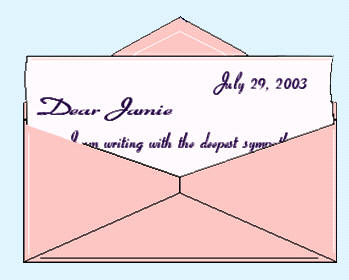
I opened the letter. It was written in French and read:
Dear Jamie,
I'm writing to express my deepest sympathy upon learning of the death of your
mother. I was saddened to read about it in an article in Le Monde, which also
detailed her remarkable life. I hope that the your loving memories will soon
eclipse the sorrow you must feel. Please extend my sympathies to your brother
and sister as well.
Much has happened to me since we last saw each other. You may have heard that I
went to Saudi Arabia to be married. The marriage was a disaster. I was very
lonely there, where women's lives are so constricted. Still, I probably would
have stayed in the marriage if my husband had not divorced me for being
infertile.
Although I am disappointed about not being able to have children - perhaps I
will do as your mother did and adopt one day - I am glad to be back home in
Egypt and free once more. I went to University and received a degree in French
literature. I am now teaching secondary school French.
I have been following your career and have read many of your articles. What an
interesting life you seem to live. I hope that your work will bring you solace
in your grief.
If you are ever in Egypt again, I would be honoured to see you.
With Regards,
Bashira.
"It's from an old friend," I said. "Condolences." There was a momentary silence
in the room.
"I know what I might like of Father's if no one else is to attached to them," I
said, slipping the letter back in its envelope and into my inside jacket pocket.
"How about those watercolours that are in the laird's room. The ones of the
castle and the loch."
"The ones by MLG," Lexie murmured.
"Mona Lisa Gilbert," Paul said. "Did your mother paint those?"
"He kept them there all these years," Meghan said with a little distaste. "Yes,
you may have them. Nobody here wants them."
"Thank you," I said and quickly, changed the subject again. "I Googled the name
Baladi last night and there are some Egyptians by that name, although there was
no Nadeem Baladi. I also looked for Qaryah, and although I found no village by
that name, there was one called Qaryat. Do you think that could be it?"
"Maybe," Paul said. It would be amazing if Father had remembered the name
correctly by the time he was telling the story to us. The place could have been
called Kar... anything for all we know."
"Well I'll look into it. If a Nadeem Baladi ever existed under that name, I
ought to be able to find him or his descendents. Is there anything I ought to
give him?"
"Hm, I don't know," Paul said. "I'll have to think about it."
"How but a picture of us with Father," Cath suggested. " Jamie could take one of
Baladi's family if they don't have one to give. It would be a reminder to both
families of the generations of people who were granted life on both sides
because of the kindness and bravery of two men."
"Good one, Cath," Paul said.
"It's very thoughtful of you to want to do this for your father," Meghan said.
"Well, I have some people to see in Cairo anyway," I shrugged. "Each trip is an
excuse to do the other."
"People, as in the letter you just received?" Lexie asked perceptively.
"Yes I smiled," patting my breast pocket and wondering where the road would take
me next. "People like that that."
The End
sections: 1 2 3 4 5 6 7 8 9 10 11