The curriculum at P.S.P. has been developed to foster the stated goals of our philosophy which follows: We believe children should be exposed to a wide variety of challenges in order to arouse their curiosity and encourage self-expression. Each child is unique and has his/her own style of learning. We respect this. At P.S.P. our goal is to provide a place where:
In addition to the planned activities, the environment, the roles of teachers, and the partnership between parents and staff complete the fuller dimensions of what we consider curriculum.
There are four main categories of learning which occur at the preschool level, and the P.S.P. curriculum is designed to focus on each of the four areas:
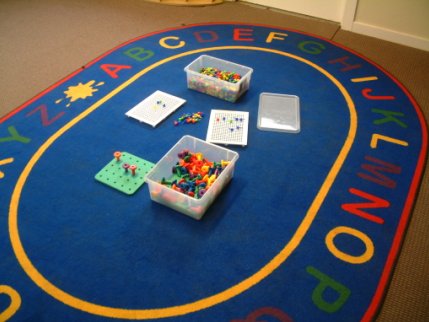
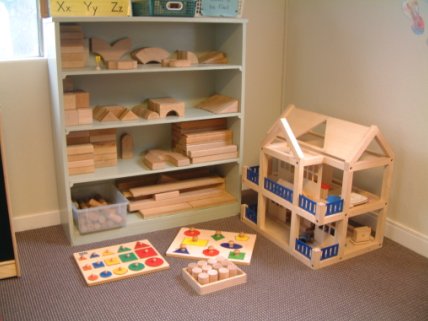
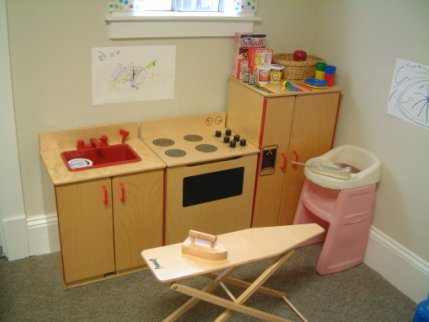
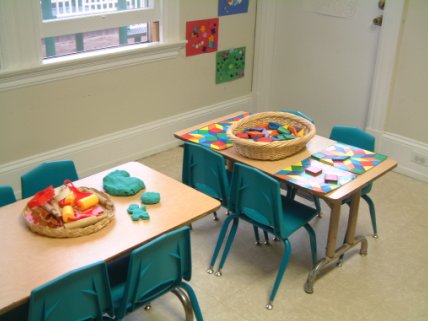
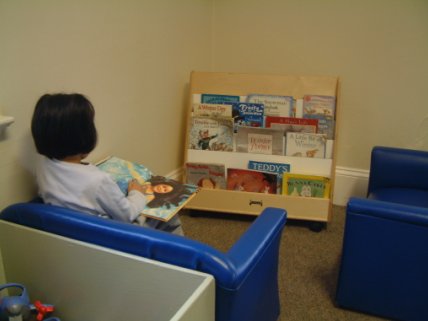
ENVIRONMENT - The way that the environment is arranged provides for learning in each of the four areas. Children are encouraged to move through the various learning centers (e.g., dramatic play, art, climbing, etc.) at their own paces and are asked to make choices based on their own interests. Children are responsible for school materials, as well as their own work; and each child has a personal space to store belongings. The social environment requires children to interact with one another; to practice turn-taking and sharing; and, to engage in social problem solving with peers. Child-sized furniture and utensils are used so that children can develop practical skills, such as pouring milk or sweeping the playhouse. Yard equipment is carefully varied so that children of differing competencies can utilize it safely and at their own levels of expertise. The presence of books and many opportunities to look at and hear them read spark children's interest in reading and writing.
PLANNED ACTIVITIES - The planned activities at P.S.P. center around varying themes. These activities provide opportunities for self-expression (art, music), discovery (physical science, nature), measuring (cooking), small muscle development (cutting, coloring, folding), sensory experience (play dough, water play), and social role-playing (dramatic play, role playing). Also, cognitive concepts regarding number, size, color, and shape are developed and reinforced through these activities. Because of this focus, children have a chance to explore a particular area in more depth; vocabulary and language skills are extended through this approach.
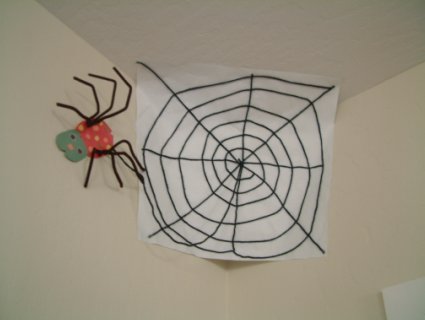
During these activities, many materials are presented and children are encouraged to use their own creativity and imagination in their work. In this way, although planned and prepared by the teachers, the curriculum becomes child-directed versus teacher-directed.

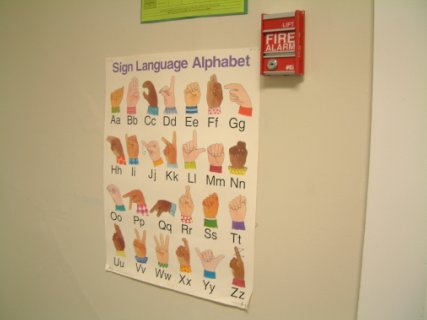
ROLES OF TEACHERS - The most important role of a teacher at P.S.P. is that of a facilitator. Teachers set up the environment, offer materials, and provide feedback so that children can discover the world for themselves. Teachers extend knowledge by posing questions and suggesting alternative approaches. As facilitators, they may intervene to help children find their own solution to a problem or they may step back and choose not to intervene, allowing children to negotiate for themselves. In every area, children must practice skills in order to master them and through this approach, our teachers give children that opportunity.
When necessary, of course, teachers will set and follow through on consistent limits; consistency being a central aspect of a predictable, and therefore, comfortable environment.
Other roles of teachers include: Role models, modeling respect and acceptance for all children and helping children learn that they can nurture and support each other, and leaders who may initiate a process or activity and then pass the leadership role on to a child.
Teachers are also essential in what we call the spontaneous curriculum, which is all those "teaching moments" that occur throughout the day. It may be a question, a discovery in the yard, or a skinned knee that provides an opening for a particular book or song or the construction of a traffic sign. Children are most motivated to learn when they are actively involved; so, it is very important that our planned curriculum be flexible enough to accommodate children's immediate interests. This spontaneous curriculum can only occur with the insight and expertise of carefully trained staff.
PARTNERSHIP BETWEEN PARENTS AND STAFF - The final piece of the curriculum puzzle is the rapport between parents and teachers. How children respond to the school environment is related to what's happening at home. Clear communication between parents and staff insures that children benefit most from the school environment, and it helps the staff to know each child and his/her needs better. And, the more parents are involved in their children's schooling, the more successful the children are in school at every level. Parents can become part of either the planned curriculum by bringing in a special activity or the spontaneous curriculum by reading a book, chatting with children at a table, etc. P.S.P. encourages this kind of parent participation in the curriculum, knowing what positive effects it has on a child's sense of self and family.
SELF-ESTEEM - Finally, self-esteem is the key. The most basic goal of all curriculum decisions is for children to be successful, but also comfortable enough with themselves to accept their limitations. By providing an environment which is developmentally appropriate for preschoolers and teachers who are knowledgeable about child development, we can offer a curriculum which fosters our goals for each child.