 |
|
|
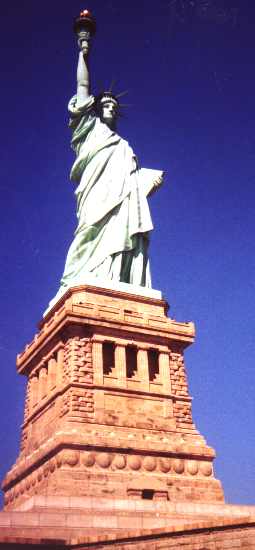
Liberty Enlightening the World That's the official title of the Statue, did you know that? Oh, we learned all KINDS of stuff. She was created by sculptor Frederic-Aguste Bartholdi, who had originally envisioned his statue to be a new "Wonder of the World". He apparently originally wanted to build it to mark Egypt's Suez Canal! However, politics kind of messed that idea up, and Edouard de Laboulaye, French historian and admirer of American political institutions, suggested that France present a monument to the United States as a gift to celebrate the Centennial of the Declaration of Independance. The Statue itself is made of extremely thin sheets of copper, over an armature designed by Alexandre-Gustave Eiffel, yes, the same guy who designed the Eiffel Tower in Paris! The Statue was a joint effort between America and France, and it was agreed that the American people were to build the pedestal, and the French people were responsible for the Statue and its assembly here in the US. However, lack of funds was a problem on both sides of the Atlantic Ocean. In France, public fees, various forms of entertainment, and a lottery were among the methods used to raise funds. In the United States, benefit theatrical events, art exhibitions, auctions and even prize fights assisted in providing needed funds. American funding for the Statue was slow, however, and Joseph Pulitzer used his newspaper to criticize both the rich who had failed to finance the pedestal construction and the middle class who were content to rely upon the wealthy to provide the funds. The famous "Liberty" poem was also written by Emma Lazarus to generate funds for the pedestal, and a children's campaign collected pennies! The statue was finished May 21, 1884, and formally presented to the U.S. minister to France, Levi Parsons Morton, July 4, 1884, by Ferdinand de Lesseps, head of the Franco-American Union, promoter of the Panama Canal, and builder of the Suez Canal. It arrived in New York Harbor in June of 1885 on board the French frigate "Isere" which transported the Statue of Liberty from France to the United States. In transit, the Statue was reduced to 350 individual pieces and packed in 214 crates. On Aug. 5, 1884, the Americans laid the cornerstone for the pedestal. The Statue was then re-assembled on her new pedestal in four months time. On October 28th 1886, the dedication of the Statue of Liberty took place in front of thousands of spectators. She was a centennial gift ten years late. It was decided that "Lady Liberty" required a commanding presence in New York harbor, and she was built on Bedloe's Island, now Liberty Island, atop what was formerly known as Fort Wood, completed in 1812, as part of the defense of New York harbor. It was one of the first things new immigrants coming into the US, heading for "processing" at Ellis Island saw, the visible, and beautiful evidence that they had arrived in "The Land of the Free". The statue weighs 450,000 lbs., or 225 tons. The copper sheeting weighs 200,000 lbs. There are 167 steps from the land level to the top of the pedestal, 168 steps inside the statue to the crown, and 54 rungs on the ladder leading to the arm that holds the torch. You can still, if you really want to, wait in a long line and then climb up to the crown, but the arm has been closed, according to the Park ranger we spoke to, since 1916, because it's just too dangerous, and put too much strain on the structure. We, however, took the elevator. It only goes to the top of the pedestal, but hey, that's 10 stories high, and we enjoyed the view! (more than standing in line for half of forever, then climbing all those stairs!!) The New Colossus Not like the brazen giant of Greek fame
|