 |
|
|
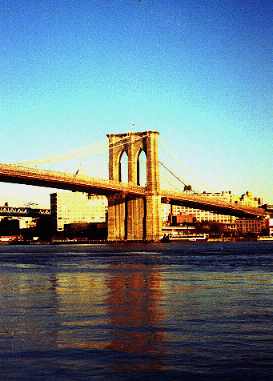
The Brooklyn Bridge After our day at the Statue, we chose to wander around just looking at various things. The Bridge was one of the things on the top of my list. We literally just stopped the car so I could jump out when we saw this view. Ok, we pulled over safely first! LOL This picture was taken from a wharf, but you know what? I can't for the life of me remember what the name of it was! LOL (There was a "famous" ship docked there, if that helps!) Actually, we were more interested in finding our friend Patricia that we were supposed to meet in this place, but our trip to the Statue took so long we missed her completely! (Good thing for us that she's a kind and patient lady!) When we couldn't locate Patricia we went snapping photos and grabbed a coffee, then headed out to wander and look at "stuff" some more. Although the New York state legislature was petitioned to build a bridge across the East River in 1802, construction on the Brooklyn Bridge project was not approved until 1866. It was designed by John A. Roebling and Wilhelm Hildenbrand. Roebling was also the inventor of the steel wire cables used as suspension cables for the bridge. Construction began in January 1870, and the bridge was opened on May 24, 1883. Roebling never saw the completed bridge, dying in July of 1869 as a result of an accident during observations to determine the exact location of the Brooklyn tower. His son, Washington Roebling took over as chief engineer. Washington Roebling suffered a permanently crippling attack of the bends during the construction of the Manhattan Caisson. He had always been a man who liked to be on site during the construction, and often he could be found inside the caisson instructing others what to do and many times doing manual work himself. Washington Roebling actually spent more hours in the working chamber than anyone else for fear that any slip might prove to be disastrous. One afternoon in the summer of 1872, Washington Roebling had to be carried out of the caisson with "caisson disease". From this point on, he remained painfully paralyzed and became known as "the man in the window," for he never returned to the site of the Brooklyn Bridge, but watched it through a spyglass from his townhouse. Roebling was determined to see the construction of the bridge to completion. He directed the construction from his townhouse; sending messages to the site via his wife Emily. At the time of it's completion, it was fifty percent longer than any bridge ever built, and it was the first ever use of pneumatic caissons. Granite used in the towers is from the same quarry as was used in Tombs prison and the reservoir in Central Park. More that 144,000 cars cross the bridge each day, and over 2500 pedestrians and 1000 bicycles cross the walkways. |