October 2007
Welcome!
Following is a travelogue of my trip to Egypt. What an extraordinary experience! It's amazing to experience both the antiquities and the current culture.
On the next 4 pages is an overview of the different sites I visited and some special experiences I had, as well as some tips for traveling comfortably in Egypt. I've included some background information and a lot of pictures, so feel free to scan through it and read as much or as little as you like. Use the index to move to the different pages.
Enjoy!
| Page 1 | CAIRO: Cairo Marriott, Cairo Museum, Giza and Sakkara: The Pyramids and Sphinx, Alexandria, The Mosque of Mohamed Ali |
| Page 2 | UPPER EGYPT: The M/S River Anuket, Cruising the Nile in Aswan, Abu Simbel, Temple of Philae, Temple of Kom Ombo, Temple of Horus at Edfu |
| Page 3 | UPPER EGYPT: Valley of the Kings and Queens, Dendera, Hot Air Balloon Ride, Karnak Temple, Luxor Temple |
| Page 4 | Tips for Traveling in Egypt |
CAIRO
Cairo Marriott and the Nile
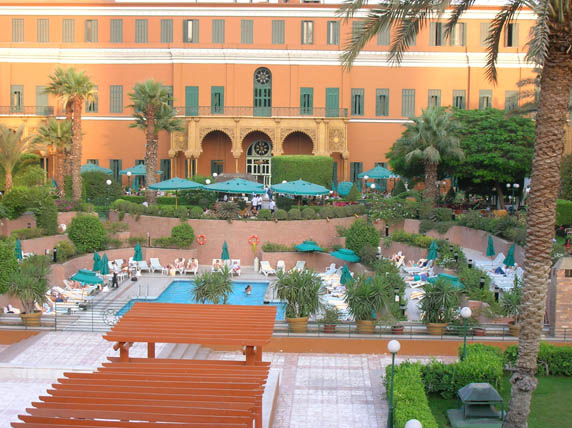
Our home in Cairo was the spectacular Marriott, a veritable Oasis on the island of Zamalek. The central part, the Palace, was built in 1869 to host visiting dignitaries for the opening of the Suez Canal. The complex includes 2 towers and a garden court section with 1089 guest rooms, 13 restaurants and lounges, banks and ATMs, several shops, a pool and a casino.
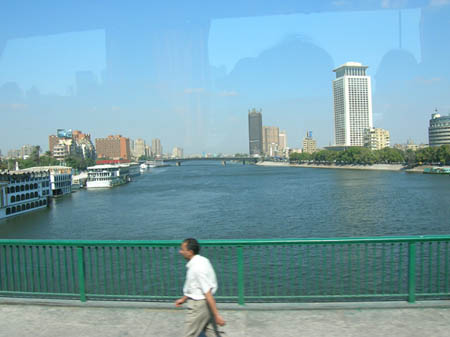
On the left is a picture of the back entrance to the Palace, along with the Garden Promenade Cafe and the pool area. On the right is a shot of the Nile from a bridge in central Cairo. Everything in Egypt is built around the Nile, so it plays an important part both economically and psychologically for the Egyptian people.
|
|
Cairo Museum
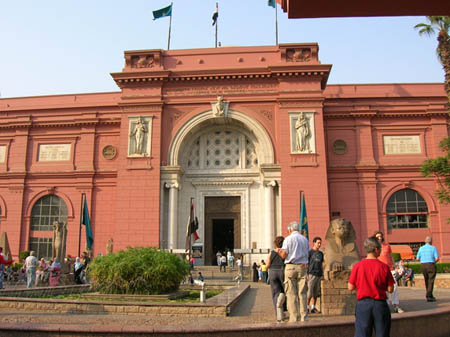
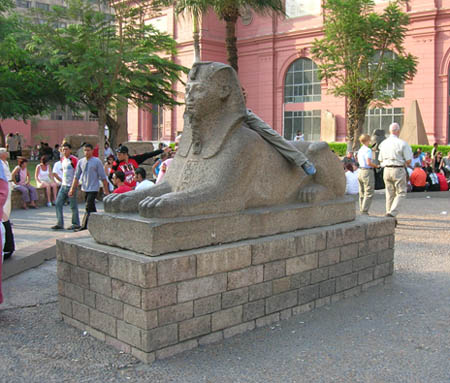
This museum houses a wealth of antiquities, including a vast array of treasures taken from the tomb of King Tutankhamen. The mummy room features the mummies of Ramses II and the newly-identified mummy of Queen Hatshepsut. Photography is prohibited inside, so please enjoy these pictures of the building and the garden in front. Note that the pond in front of the building features the 2 important plants of ancient Egypt: papyrus in the center and lotus surrounding it.
 |
 |
This small museum can't begin to hold the wealth of the antiquities it owns, so a new museum is currently being built in Giza, near the pyramids, where many more will be displayed.
Giza and Sakkara: The Pyramids and Sphinx
The pyramids are, of course, a highlight to any visit to Egypt. You've seen many pictures of the pyramids — the background of these pages shows the Great Pyramid of Cheops and the Pyramid of Chephren, the top of which retains some of the outer limestone casement that gave the pyramid its smooth finish. The pyramids were built by pharaohs of the Old Kingdom and lie on the west bank of the Nile, near Cairo.
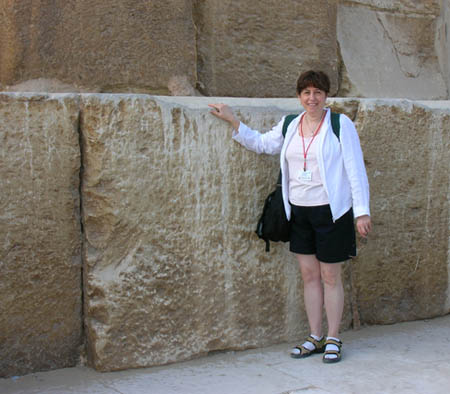
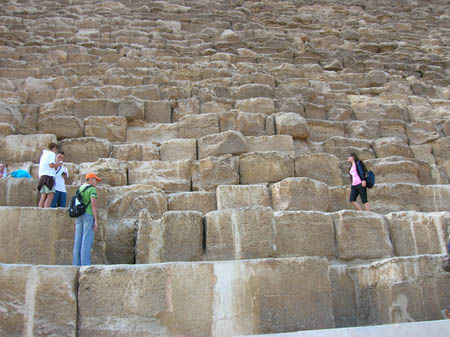
Here are a couple of pictures to help you get a sense of perspective of the size of the stones. That's me on the left, in front of the Great Pyramid. I'm 5'3". You can imagine how big and heavy these stones are!
 |
 |
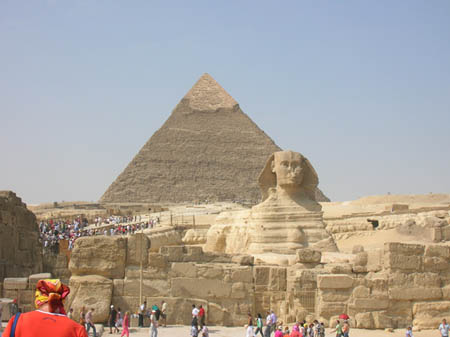
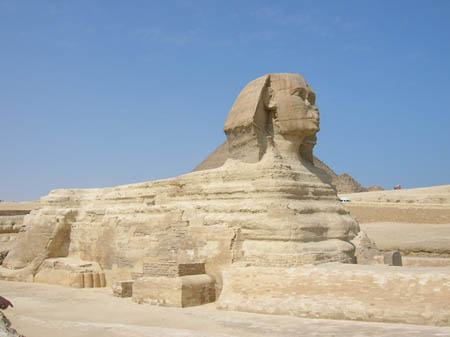
No visit to Giza would be complete without a visit to the Sphinx, which is in front of the second pyramid, the Pyramid of Chephren.
 |
 |
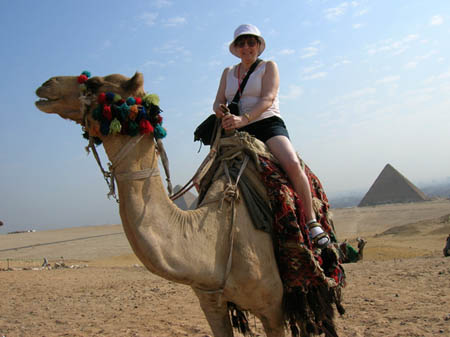
I also had the opportunity to have a brief ride on a camel. Notice how relaxed and happy I am (not!). The camel is "smiling" now, but he got a little feisty when I was getting on. Five minutes was more than enough!
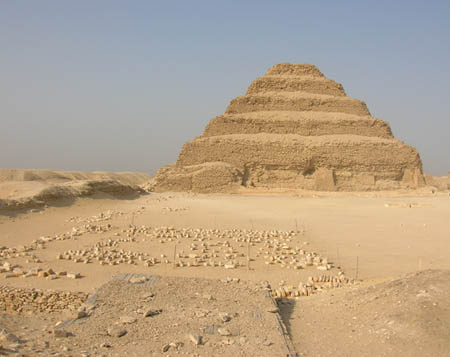
The Step Pyramid at nearby Saqqara is the oldest of Egypt's 97 pyramids and the first stone tomb built for a king. It was built during the 3rd Dynasty by King Djoser's architect, Imhotep, the greatest architect of ancient Egypt. This was my favorite!
Alexandria
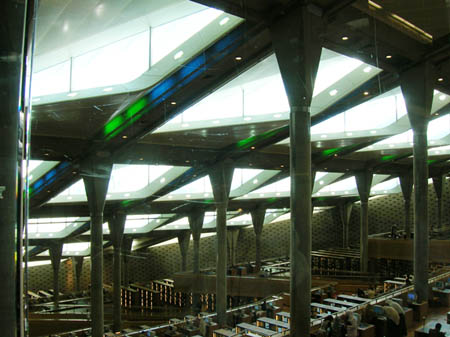
Alexandria was one of the great intellectual centers of the ancient world. Sadly, the great library, with its invaluable contents, was destroyed by fire. The new Bibliotheca Alexandrina was inaugurated in 2003 near the site of the ancient library. It's one of the most beautiful modern structures in Egypt. The shutters are designed like eyelids, to allow the light in, but shade the interior from the sun.
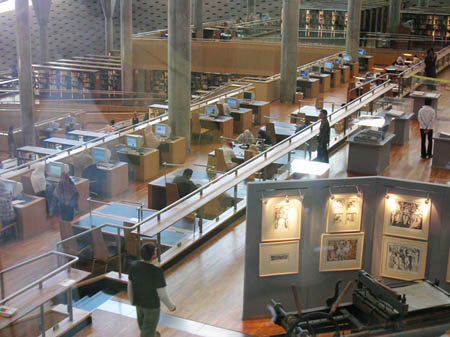
These are 2 interior shots. The one on the left shows the "eyelids," and the one on the right shows the reading and computer room, with a little bit of the gallery. A sharp contrast to the ancient villages and farms we'll see when we head south!
 |
 |
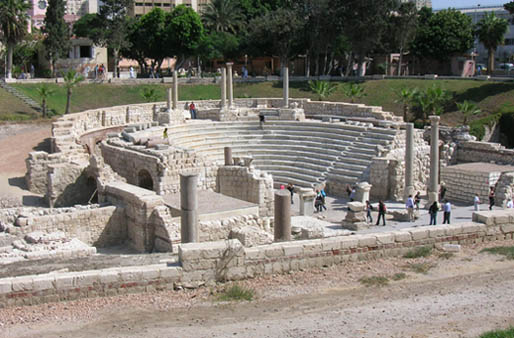
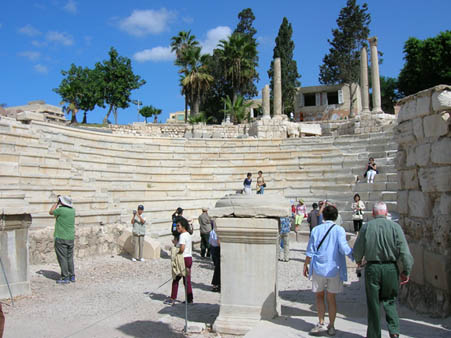
Other highlights of Alexandria include the Roman amphitheatre . . .
 |
 |
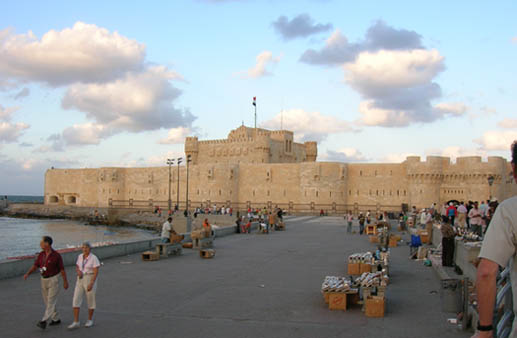
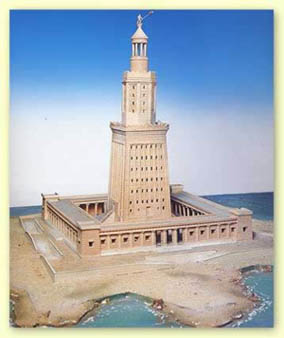
. . . Qaitbey Fort, which is on the site of the ancient Pharos Lighthouse, one of the 7 Wonders of the World . . .
 |
 |
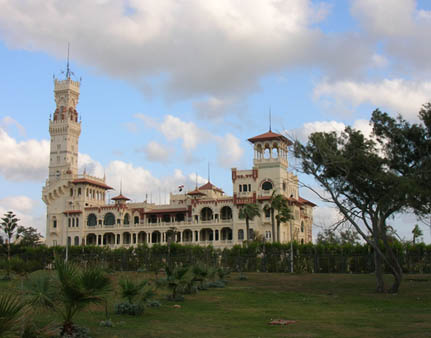
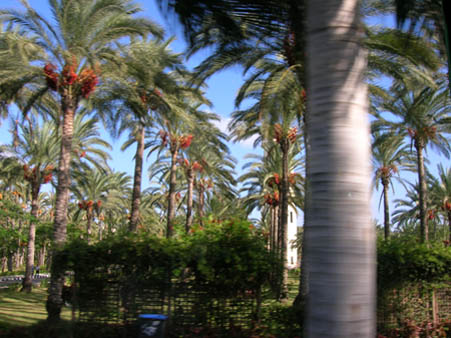
. . . and the beautiful Montaza Palace, built in 1892 by the royal family, with its surrounding gardens, filled with date palms.
 |
 |
The Mosque of Mohamed Ali
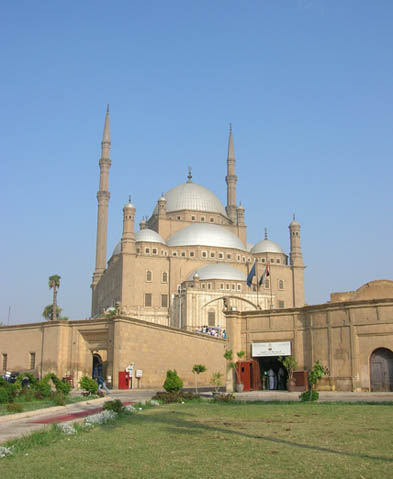
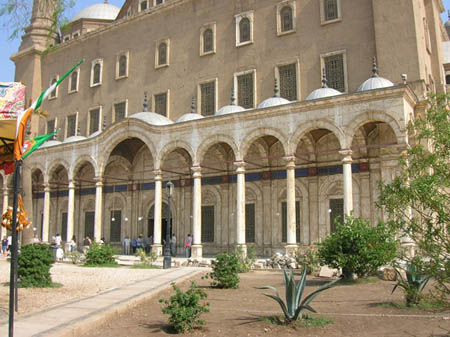
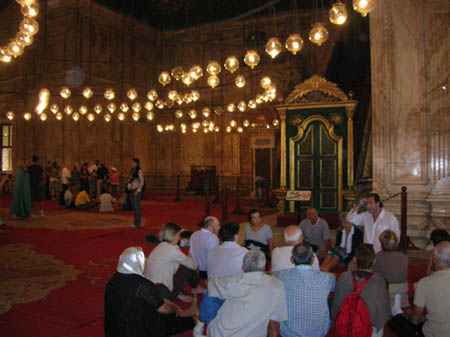
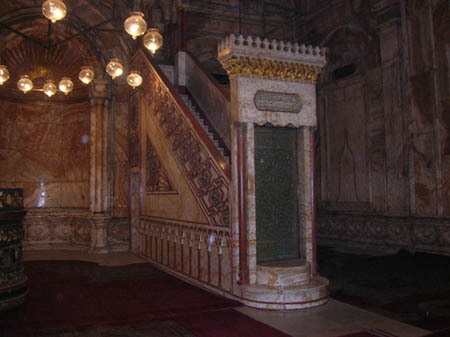
This mosque, also called the "Alabaster Mosque," resides on a hill overlooking Cairo in the area called the Citadel, the site of a former fort and royal residence. It was built by the Ottoman ruler, Mohamed Ali Pasha, one of the great builders of modern Egypt, between 1830 and 1848. The style is called "Ottoman Baroque."
 |
 |
 |
 |
Click here to go to page 2.
Click here to go to the top of this page.
Click here to go to Sharon's Good Life Coaching website.